Introduction
Artificial Intelligence, commonly called AI, is no longer something only engineers, computer scientists, or large companies talk about. It is now becoming part of education, careers, businesses, research, communication, and daily life. From writing assistance and online learning to healthcare, banking, agriculture, and customer service, AI is changing how people study, work, and solve problems.
For students and young professionals in Pakistan, especially in Balochistan, understanding AI is becoming very important. The goal is not that every student must become an AI engineer. The real goal is that every student should understand what AI is, how it works at a basic level, where it can be useful, and how to use it responsibly.
This article explains AI in simple language and shows how students can prepare themselves for a future where AI skills will matter in almost every field.
What Is Artificial Intelligence?
Artificial Intelligence is a technology that allows computers and digital tools to perform tasks that usually require human intelligence. These tasks can include understanding language, recognizing images, answering questions, finding patterns, making predictions, and helping people make decisions.
For example, when a student asks ChatGPT to explain a difficult topic, when YouTube recommends a video, when Google Translate converts one language into another, or when a mobile phone camera improves a photo automatically, AI is working in the background.
AI is not magic. It works by learning from data, patterns, examples, and instructions. The better the data and design, the more useful the AI system can become.
Why AI Matters for Students
Students today are preparing for a world where digital skills are becoming as important as reading, writing, and communication. AI can help students learn faster, organize ideas, improve writing, explore career options, and understand complex subjects.
For example, a student studying biology can use AI to summarize a research article. A business student can use AI to study market trends. A computer science student can use AI tools to understand code. A social sciences student can use AI to explore survey questions or organize interview themes.
The students who understand AI early will have an advantage because they will know how to use modern tools instead of being afraid of them.
How AI Is Transforming Education
Education is one of the biggest areas being changed by AI. Students can now access explanations, examples, summaries, quizzes, and learning support more easily than before.
- Personalized learning: AI can help students learn at their own speed and focus on weak areas.
- Writing support: AI tools can help students improve grammar, structure, and clarity.
- Research support: AI can help students understand articles, find ideas, and organize notes.
- Language support: AI translation tools can help students understand content in different languages.
- Exam preparation: AI can create practice questions, summaries, and revision plans.
However, students should not use AI to avoid learning. AI should support learning, not replace effort, reading, thinking, or original work.
How AI Is Changing Careers
AI is also changing the job market. Many careers now require people to understand digital tools, data, automation, and AI-supported workflows. This does not mean AI will remove every job. It means many jobs will change, and people who learn AI tools will be better prepared.
AI is already being used in fields such as education, healthcare, business, marketing, agriculture, journalism, design, law, finance, customer support, software development, and research.
For example, a graphic designer can use AI to generate ideas. A teacher can use AI to prepare lesson plans. A researcher can use AI to summarize literature. An entrepreneur can use AI to understand customers and plan content.
AI in Daily Life
Many people use AI every day without realizing it. It is present in mobile phones, search engines, social media platforms, navigation apps, online shopping, digital banking, and entertainment platforms.
- Search engines use AI to show better results.
- Social media platforms use AI to recommend posts and videos.
- Maps use AI to suggest routes and estimate travel time.
- Email apps use AI to detect spam and suggest replies.
- Online stores use AI to recommend products.
This is why AI awareness is important for everyone, not only technology students.
Common Misconceptions About AI
- AI is only for computer science students. This is not true. Students from every field can use AI tools.
- AI will replace all jobs. AI will change many jobs, but it will also create new opportunities for skilled people.
- AI always gives correct answers. AI can make mistakes, so users must verify information.
- Using AI means cheating. Responsible use of AI for learning, brainstorming, and improving understanding is different from copying work dishonestly.
Responsible Use of AI
Using AI responsibly is very important. Students should not copy AI-generated answers and submit them as their own work. They should use AI to understand topics, improve drafts, ask better questions, and organize ideas.
A responsible student should always check facts, read original sources, cite properly, and think independently. AI can help you learn, but it cannot replace your own judgment, honesty, and effort.
AI is most useful when students use it as a learning assistant, not as a shortcut.
Important AI Skills Students Should Learn
Prompt Writing: Learning how to ask clear and useful questions to AI tools.
Critical Thinking: Checking whether AI answers are accurate, balanced, and reliable.
Research Skills: Using AI to support reading, note-taking, and literature review.
Digital Ethics: Understanding privacy, plagiarism, bias, and responsible use.
Career Planning: Exploring how AI affects different professions and industries.
Communication: Using AI to improve writing, presentations, and learning materials.
AI and Research
AI is becoming a powerful support tool for research. Students can use AI to understand difficult papers, generate research questions, compare ideas, summarize long documents, and improve academic writing.
Tools such as ChatGPT, Perplexity, Elicit, and Consensus can help students explore academic topics. But students should always verify sources and avoid depending only on AI-generated content.
For undergraduate students, AI can make research less intimidating. It can help them take the first step, but real research still requires reading, evidence, methodology, ethics, and proper guidance.
Why AI Awareness Matters in Balochistan
Young people in Balochistan need access to modern skills that can help them compete academically and professionally. AI awareness can support students in education, freelancing, entrepreneurship, research, and career development.
When students from Balochistan understand AI, they can use it to solve local problems, improve learning, build digital careers, and contribute to community development.
This is why AI education should be accessible, simple, and practical for everyone.
How BELI Supports AI and Digital Learning
The Balochistan Emerging Leaders Initiative (BELI) works to empower young people through education, leadership, digital skills, research awareness, and professional development opportunities.
Through programs, workshops, webinars, and learning opportunities, BELI helps students understand modern skills such as AI, research, communication, leadership, and innovation.
Students interested in technology and future skills can also explore BELI programs such as the AI & Technology Programs and other opportunities listed on the BELI Programs page.
Upcoming BELI Webinar: AI for Everyone
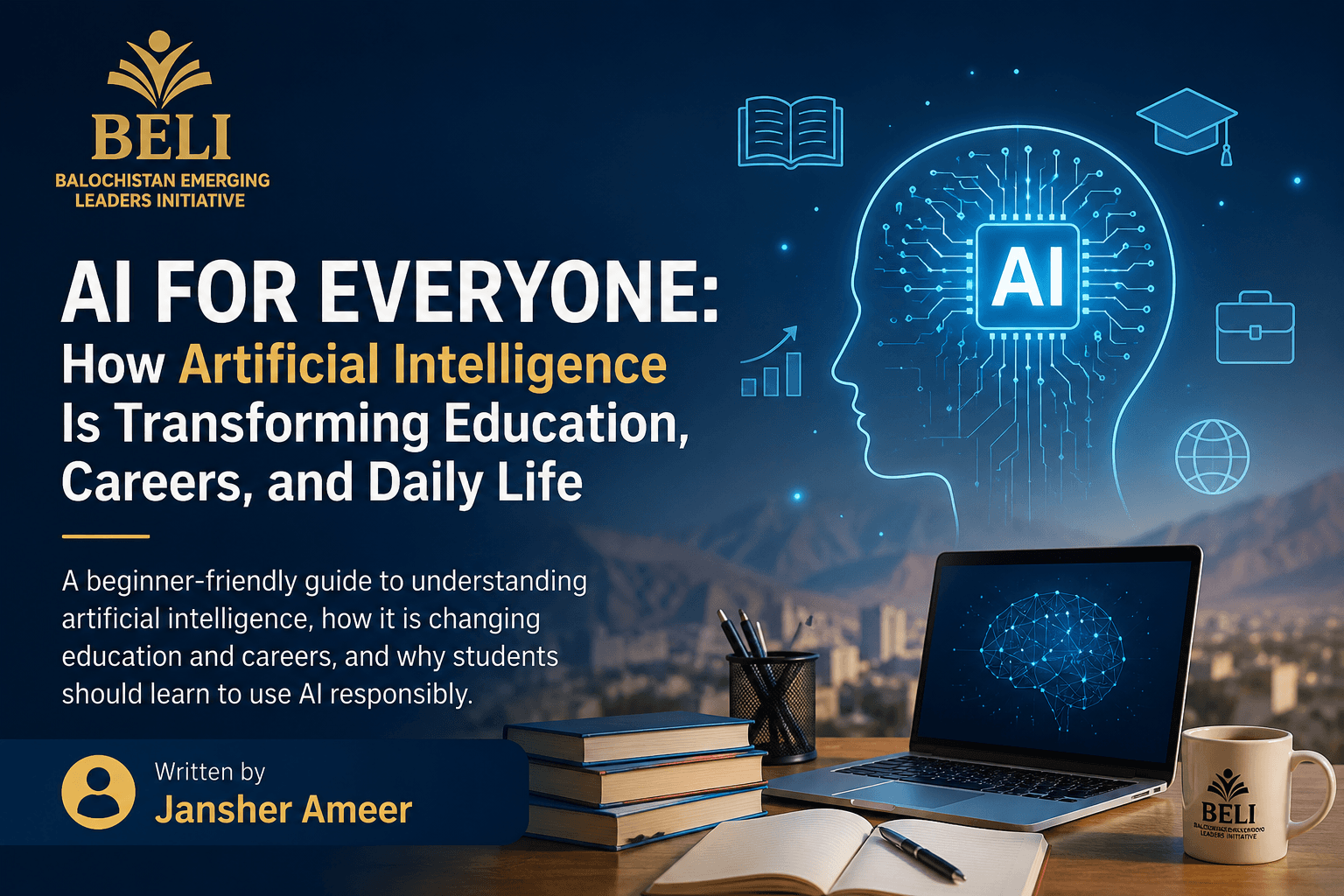
To help students, young professionals, researchers, and aspiring leaders understand AI in a simple and practical way, BELI is organizing an online webinar titled AI for Everyone: How Artificial Intelligence is Transforming Education, Careers, and Daily Life.
The webinar will discuss how AI is changing learning, work, research, and everyday life. It is designed for beginners, so students from all academic backgrounds can join.
- Date: Sunday, June 14, 2026
- Time: 06:00 AM
- Mode: Online
- Certificate: E-Certificate
If you want to understand AI and prepare yourself for the future, this webinar is a good place to start.
Conclusion
Artificial Intelligence is changing the world, but students should not feel afraid of it. Instead, they should learn how it works, where it can help, and how to use it responsibly. AI can support education, research, career planning, creativity, and daily productivity.
The future will belong to students who can combine human skills such as critical thinking, communication, ethics, and creativity with modern tools like AI.
If you are ready to begin learning, join the upcoming BELI webinar and take your first step toward understanding AI.